
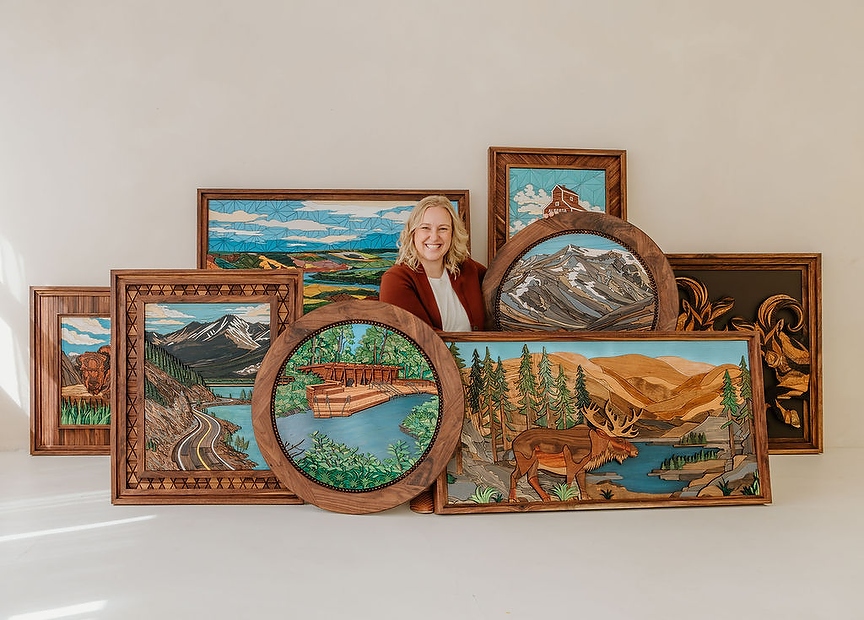
Editor’s note: Below is a submission from Fort St. John artist Becky Banack, speaking about her connection to the Alaska Highway, which would lead to what she describes as her “most personal body of work.”
Her exhibit, The Highway That Built the North, is currently on display at the Dawson Creek Art Gallery until June 30.
Portions of the piece have been edited from its original submission. This article was written by Banack’s friend and copywriter, Kim Rose.
The Alaska Highway begins in Dawson Creek. That is not a metaphor.
There is a sign at the corner of 10 St. and Alaska Avenue that says Mile Zero, and every mile of road north of it was built on the back of one of the largest construction projects in North American history.
In the summer of 1942, more than 10,000 soldiers and civilians pushed through muskeg and mountains to connect Dawson Creek to Fairbanks, Alaska, in eight months.
Among them was a young man who would later become Becky Banack’s grandfather.
He came to Dawson Creek to help build the highway.
He would stay to homestead in the Peace River region, and the road he helped carve through the northern wilderness became, decades later, the backbone of his granddaughter’s most personal body of work.
Banack is a wood artist based in Fort St. John and the founder of Blind Creek Studios.
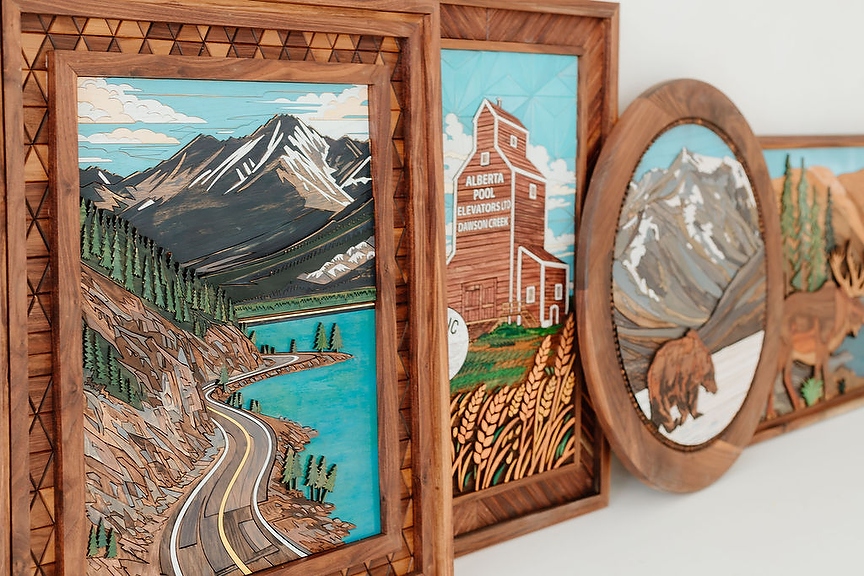
She has been making layered wood artworks for years, building pieces from stacked and shaped wood that carry colour, texture, and story in a way that she feels more alive than paint on canvas.
For her latest collection, she did something she had long wanted to do: she drove the highway.
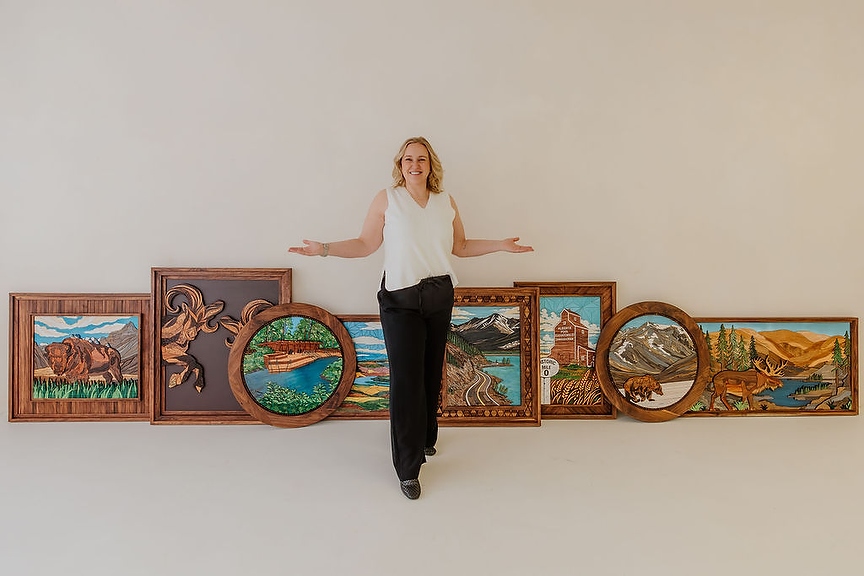
In her memory, in her hands, in eight pieces of layered wood that now make up The Highway That Built the North.
The exhibition at the Dawson Creek Art Gallery runs to June 30.
Eight artworks, each one tied to a specific place along the Alaska Highway, hang in the gallery from south to north, the same direction you would drive the road. It starts at Mile Zero and ends near the Alaska border, just shy of Beaver Creek, Yukon.
The eight places are not chosen at random.
First Mile North anchors the show at Dawson Creek itself.
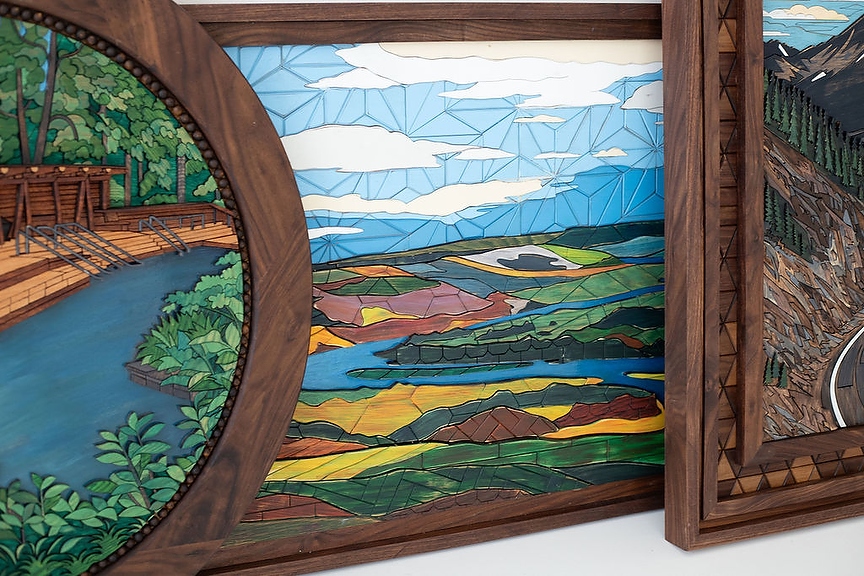
Pieces of the Valley looks out over the Peace River from Mile 35, a view Banack knows intimately from her own acreage.
High Country Duel takes you into Summit Pass at Mile 392, the highest point on the entire highway, where Stone Sheep cross the road on their own schedule.
Driving the Edge follows the turquoise water of Muncho Lake at Mile 462.
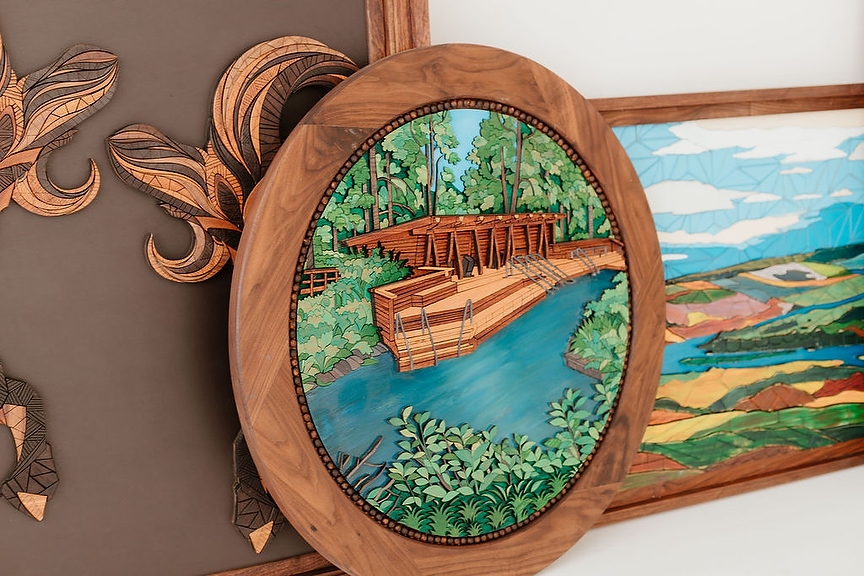
Liard: A Warm Pause arrives at the hot springs at Mile 496, a place Banack has been visiting since she was a child.
Then the highway crosses into the Yukon.
Guardians of the Highway captures the Wood Bison that cross the road near Coal River at Mile 533.
Moose of Laberge rests at the wide open water of Lake Laberge at Mile 914.
And Guardian of the North closes the show near Beaver Creek at Mile 1202, with a bear stepping out of the wilderness for just a second before it disappears.
Walk the gallery, and you have driven the highway.
That is the intention, and it is not accidental.
Banack grew up in the Yukon. She moved there in Grade 1, and the Alaska Highway was simply part of how life worked.
You drove it to get places. You stopped at Liard. You watched for animals. You knew the rhythm of the road the way you know the layout of your own house.
Liard Hot Springs is the piece she describes as her most personal.
Her family has been stopping there since she was small.
It is a place tied to every stage of her life, from childhood to bringing her own kids to do the same thing she did.
Morning coffee in her grandmother’s trailer. Campfires. Cards. Staying up too late. The long walk along the boardwalk looking for moose and bears and, always, the reclusive turtle nobody has ever actually found.
That kind of memory does not fit neatly into a single image, but Banack has been trying to find a way to hold it anyway.
For this collection, she made a deliberate choice to work differently than she usually does. Rather than her usual approach, she used wood stains throughout, letting the natural material carry the colour and depth of the landscapes she was trying to capture.
The result is warmer, more textural, more like the land itself.
It is, she says, the first body of work she has made that feels truly from her heart.
The Alaska Highway is infrastructure. It is also a myth.
It is a road that connects communities separated by hundreds of kilometres of wilderness, and for the people who live along it, it is simply home.
The Peace Region sits right at the beginning of it, and the Yukon lies further along; between them, the road passes through some of the most quietly extraordinary landscapes in the country.
Banack is not the first person to try to capture what this road means. But she may be the first to build it in wood, layer by layer, place by place, memory by memory.
The exhibition runs from June 6 to June 30.
More information and a full gallery of the works can be found at blindcreekstudios.ca/alaska-hwy-collection.












Follow Us