
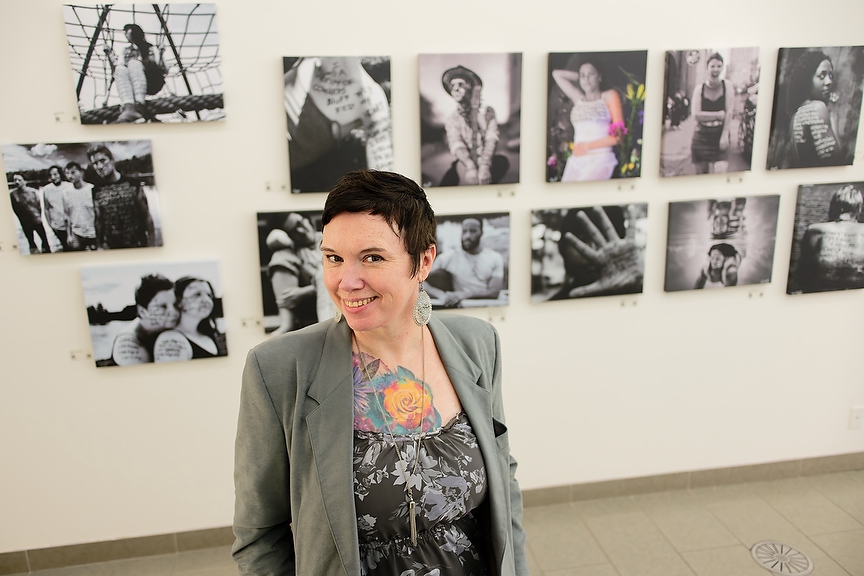
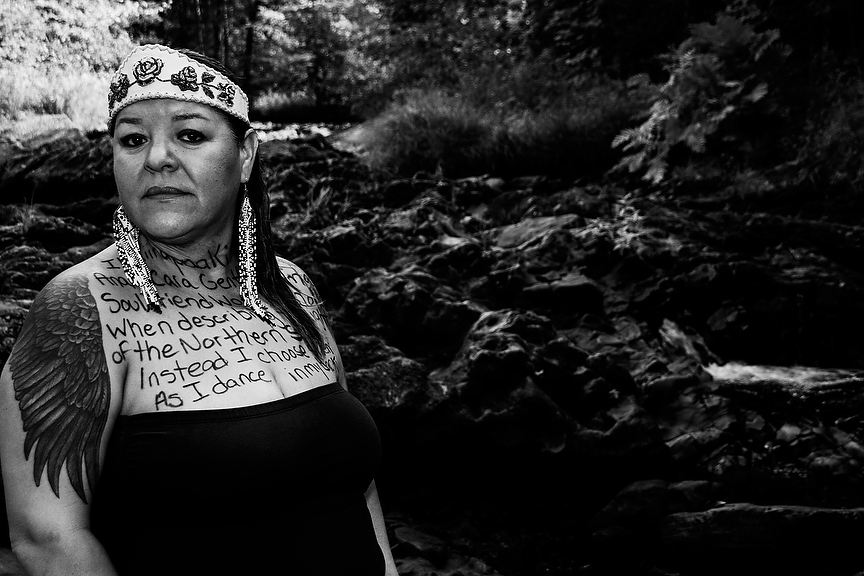
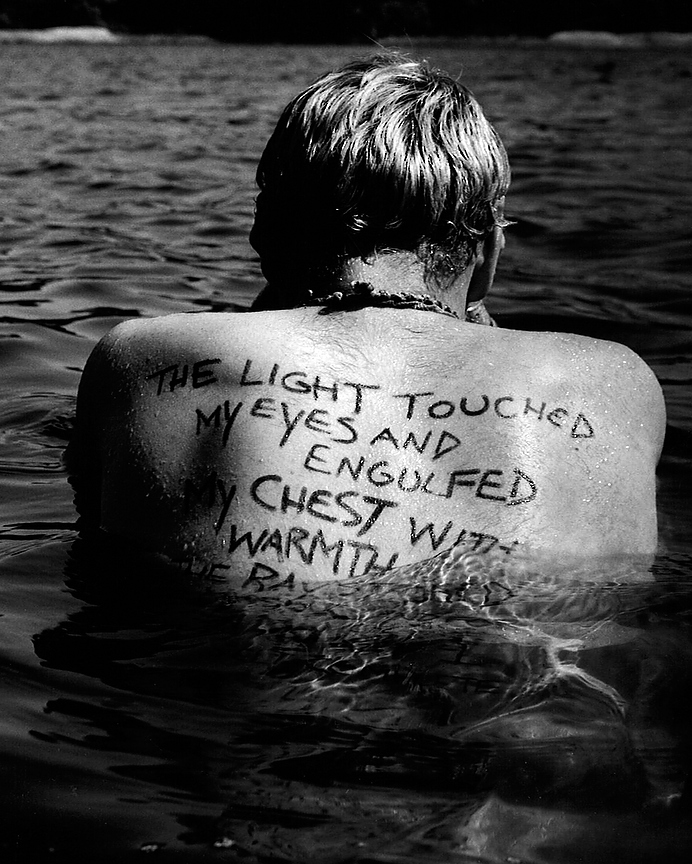
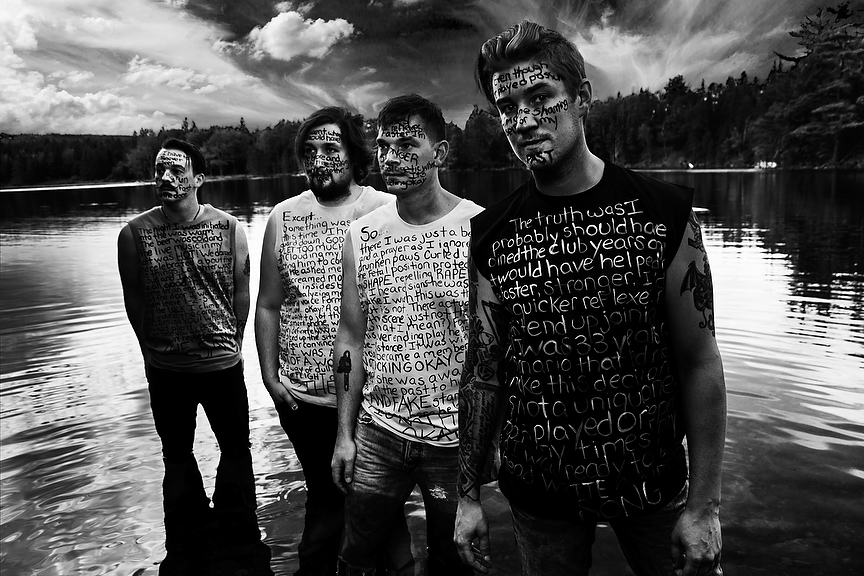
Poetry is spilled across the bodies of the subjects of Cara Jones’ photographs in her exhibit People Paper.
Jones has been working on the multimedia-photography project for about 27 years, and she has watched as the world has changed around her.
“I’ve changed as an artist and a person when I look back at younger me, and I look at young artists now, I think of how much time I wasted not believing in myself and having imposter syndrome,” Jones said.
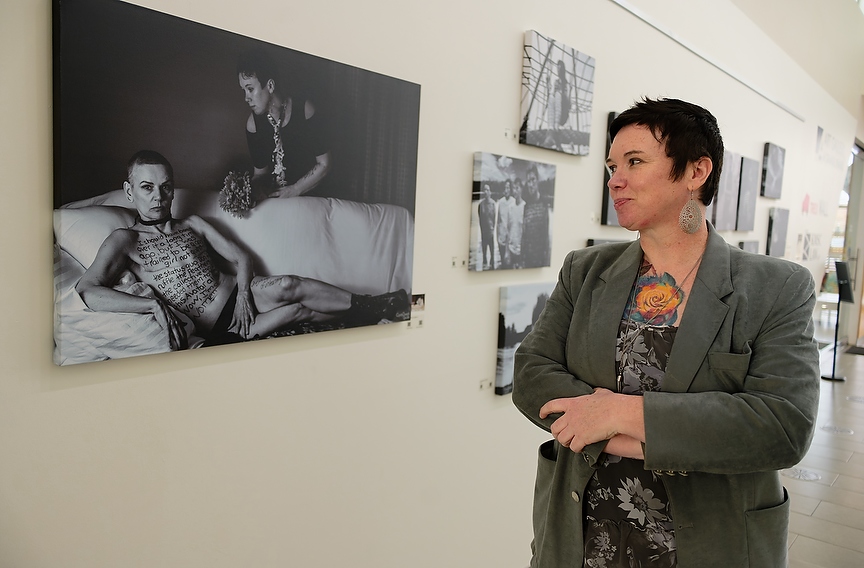
The project was initially shot on film and would later evolve to digital cameras.
Poetry from throughout Jones’ life found new life in the photos, and once again, when it was recorded to create a multimedia experience for the exhibition, hanging on the Travelling Exhibitions Program Northwest (TREX) wall outside the Art Gallery of Grande Prairie.
“Just to have that accessibility is an amazing aspect to add to an exhibition, for sure,” said Jamie-Lee Cormier, TREX Northwest curator.
The exhibit features two QR codes: one provides a description of the image, and the other includes Jones reading the poem.
“Jones’ work really spoke to me because there’s such a story behind her work with her photography that she’s known for, and the written pieces that are on the models.”
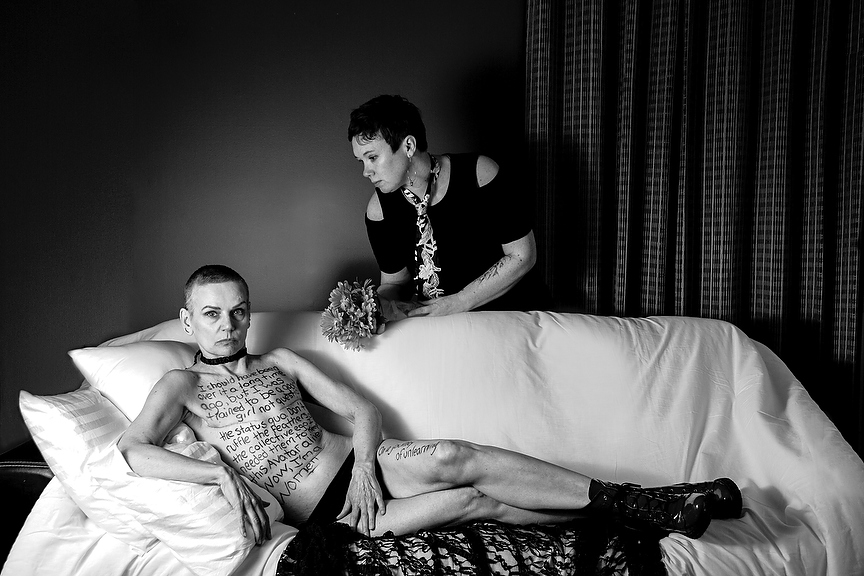
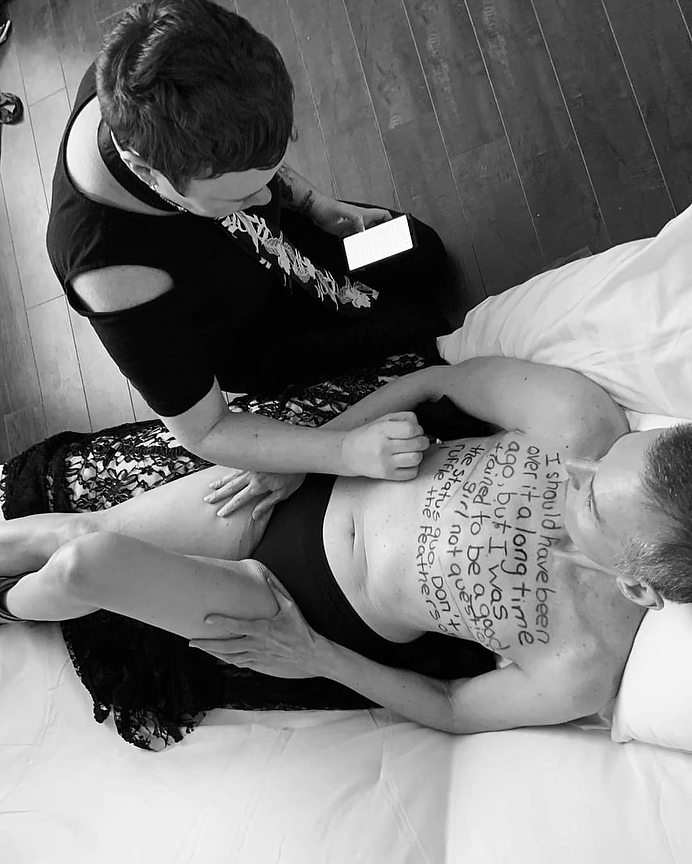
The largest photo in the exhibit shows artist Tina Martel sitting topless on a chair, staring directly into the camera, while next to her, Jones adores her.
Jones received a request from Martel to participate in the People Paper project. Martel had recently had a double mastectomy and understood the problems of doctors not listening to a woman.
The photo imitates Édouard Manet’s painting Olympia, and the poem Jones chose was one that the two women could relate to.
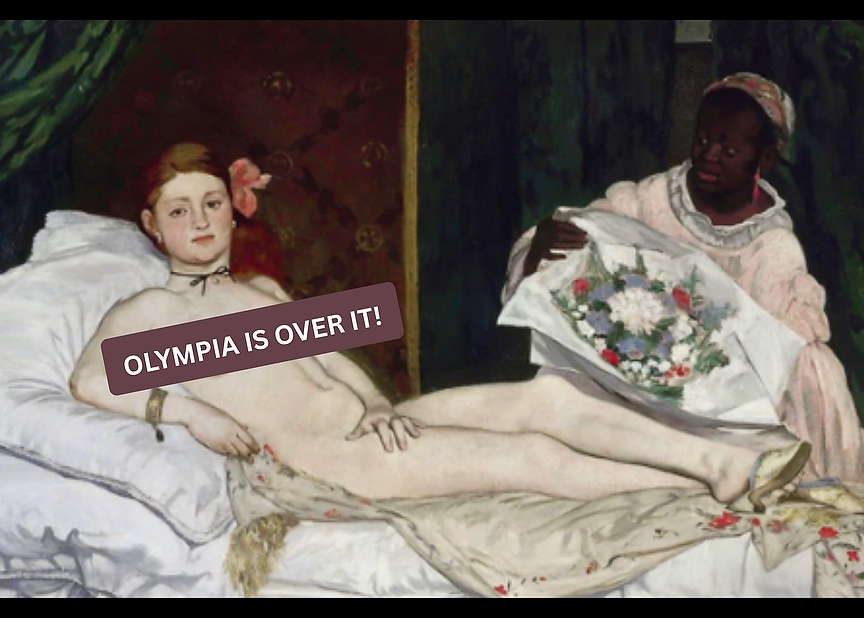
“I wrote a poem called Olympia’s Over It, and it was about my struggle of being diagnosed with ADHD when a doctor told me that I had achieved too much in life to have that,” said Jones.
Martel gazes directly at the viewer, with a look that Jones describes as saying, “We are over it. Women need to be believed when it comes to our health.”
“It’s one of the most important pieces that I’ve ever created in the exhibition,” said Jones.
The Beginning
People Paper’s origins are deeply rooted in Jones’ own history.
Growing up in Antigonish, Nova Scotia, also known as the Little Vatican, started shaping her view of the world.
“One of the things I was noticing at school and in my early 20s was this idea as a woman who I was in this world, I grew up in this Catholic town where I didn’t feel heard, I felt objectified,” she said.
It was around this time that she learned about her birth parents, who gave her up for adoption after being pressured by family and the church.
She would not know that her birth parents were about six doors from her home until she was about 20 years old.
Additionally, she was recovering from brain surgery to treat epilepsy.
Jones explained this as a time of change: the early days of the internet, the end of the Cold War, and the rise of reality TV.
Jones says she was first introduced to photography in her first year of university in 1997 at NSCAD. She remembers heading to the first day of classes after learning about the death of Princess Diana.
Her time at art school would introduce her to the work of photographers Francesca Woodman and Duane Michals.
Woodman’s work exploring the body and using it to tell stories, and Michals’ photographs paired with his handwritten notes, helped Jones reflect on how she could convey her journey through photography.
“I was really trying to explore who I was, and what was my identity,” she said.
The first photo of the project would then be created.
“It started with my first image of myself, where I wrote the name Margeaux on my face, which was my birth name, so it was called Margeaux versus Cara,” she said.
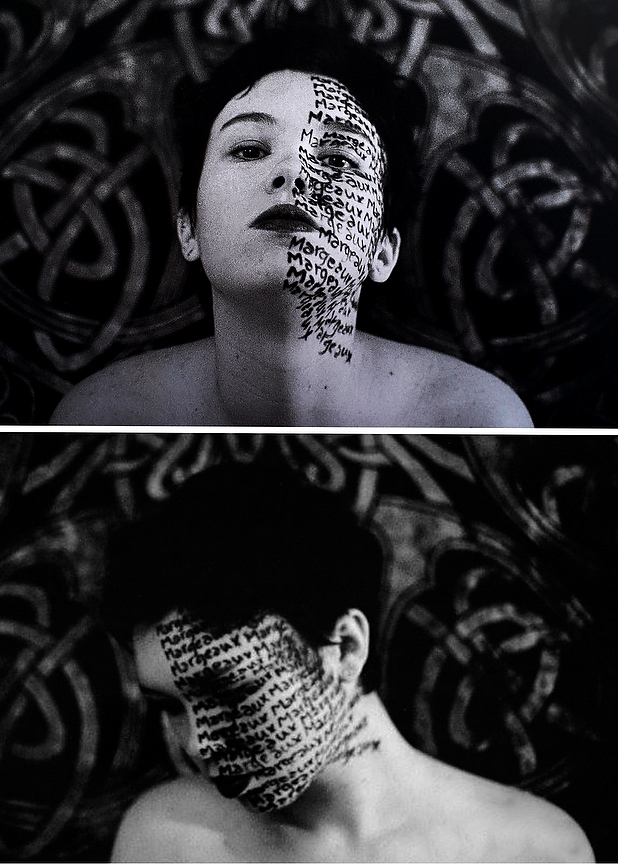
It would kick off the thinking by asking questions such as, “What does it mean to be somebody?” and “What creates our identity, and how do we explore that as artists?”
Jones reminisced about her days in elementary school and how she enjoyed when her peers wrote on her jeans.
The practice continued in art school, where she would get her friends to write her poetry on her before heading out for a night of dancing.
“I’ve been writing poetry since… I could write, pretty much, doesn’t necessarily mean it’s great poetry, but that’s the thing about being an artist, is that you need to be able to get out of your own way, and experience how you change.”
She said artists can be their worst critics, but over time, can return to their work to find the good in it.
“If you want to meet the worst critics, go to an art school, and you’ll see students up all night long; they are their own worst critics.”
“I think it’s important that we have more faith in ourselves, and just do it because you love it, not because you’re always thinking how to make money from it.
“In art school in the ’90s, it was constantly, you’re never gonna make it, one in one million people make it, and if anyone had to listen to that, none of us would have done anything.”
Jones began by adding her poetry to people and photographing them, because “I wanted to write my poetry on people and take photos.
“I had no idea why I was doing it. I just wanted to.”
Armed with a Mamiya twin lens reflex camera, she headed out to Long Lake in Halifax to write poems on her friend.
“I wanted to write this poem about how it feels to be in nature, and how you have those moments of just bliss on your own, and where it says, “The light touched my eyes, and engulfed my chest with warmth.”
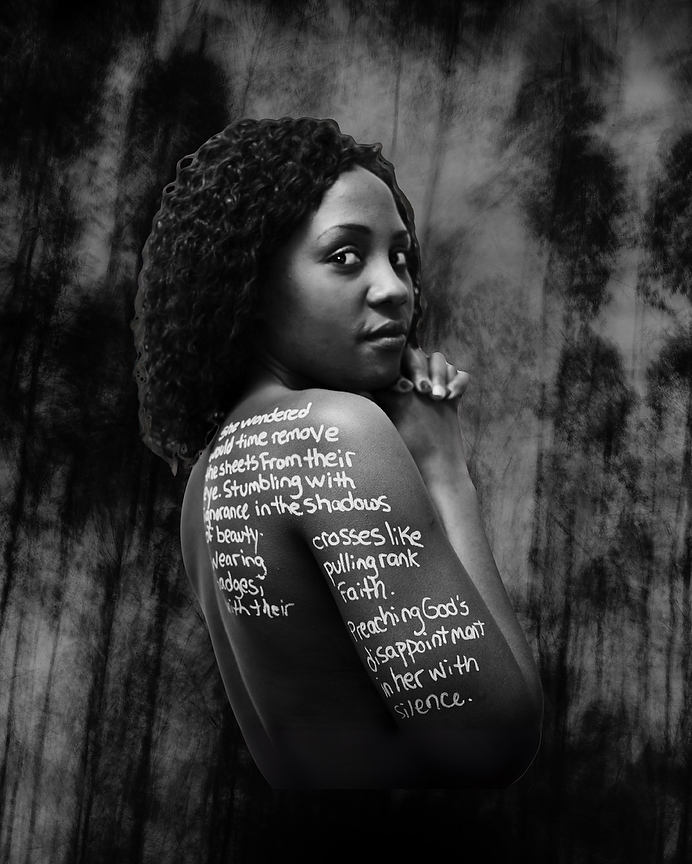
Those photographed in People Paper have had Jones recite the poem to them before she begins to write it on their skin, often with black eyeliner.
In 2024, Michelle Renee Dacyk was photographed by Jones for People Paper.
“I love the poem that she picked for me, called The Difference, and it just really captured where I was at, but obviously where she was at too.”
Dacyk recalls Jones reading two poems to her before beginning the photographic process, and The Difference resonated with both of them in that moment.
Jones often has an assistant come and document the reading and writing of the poem on the person, as she sees it all part of the process.
“There is something about the experience and the intimacy of writing your words on somebody, them trusting you with those words, and that you’re going to portray them in a way that they’re okay with,” Jones said.
The flâneur
While in school, Jones learned about the flâneur.
The French term was used to describe an urban stroller, urban explorer, and connoisseur of the street.
Jones describes the flâneur as a “highly observant urban wanderer who takes in everything they see as they seek experiences that fuel their creative minds.”
“I really related to that in the late 90s and early 2000s, because I was seeing everything change.”
She then told her professor that she wanted to be a flâneur, to which he replied that she couldn’t because she was a woman.
After art school, Jones travelled to Korea, then did an apprenticeship in Australia, and returned to Canada with a son.
It led the newly single mother “to address my identity because I had no idea who I was at this point.”
She remembers crying at the kitchen table, thinking she was no longer an artist.
“I couldn’t think of anything creative.”
She said that soon after, she received a card from artist Rita Van Tassel that said, “Art is not something you do; it’s a part of who you are.”
Lost photos
In 2012, Jones went through a self-proclaimed “minimalist phase,” which incidentally included the disposal of the original negatives of the first People Paper photographs.
The photos were only found after Jones told a friend she had lost the negatives, and the friend revealed that they had stored prints in a filing cabinet, saving some of the lost photographs.
“I never thought I was going to ever see these images again,” said Jones, who then scanned the photos and digitized them for reprinting.
Jones moved to a digital camera in 2007 and has continued the project in the digital landscape.
Jones says they remember being in art school and learning about Adrienne Salinger’s photographic series In My Room: Teenagers in their Bedrooms, which was photographed throughout the 1980s and released in 1995.
She remembers being in art school, thinking she could never imagine working on a project that long.
“I think I’m still very similar to who I was in my 20s, I think that the world has a way of beating you down sometimes, but I also think that that’s also great content for your work as an artist. I prefer less of that, but on reflection, it is amazing to capture it in both a visual way and a literal way.”
People Paper now spans decades, and it also captures the passing of time, cultural changes, and new media types, all through Jones’ creative outlooks, making her a flâneur of the modern day.






Follow Us