
Editor’s Note: On April 5, photographer David Kay headed out onto the trails in Kleskun Hills with his camera. This is an account of what he experienced.
Yesterday, I came across a challenging, exciting, and poignant scene while I was snowshoeing in Kleskun Hills Provincial Park.
I started in the natural area and went up onto the north ridge, across to the upper pond, down to the south pond and then along the south-east base of the hills.
I have done this circuit several times, often seeing large herds of mule deer, and occasionally moose or coyotes.
While on this snowshoe hike, I photographed a few snow drifts to show how much snow is still in the Park.
As you know, in the Grande Prairie area, we have had a significant accumulation of snow this winter.
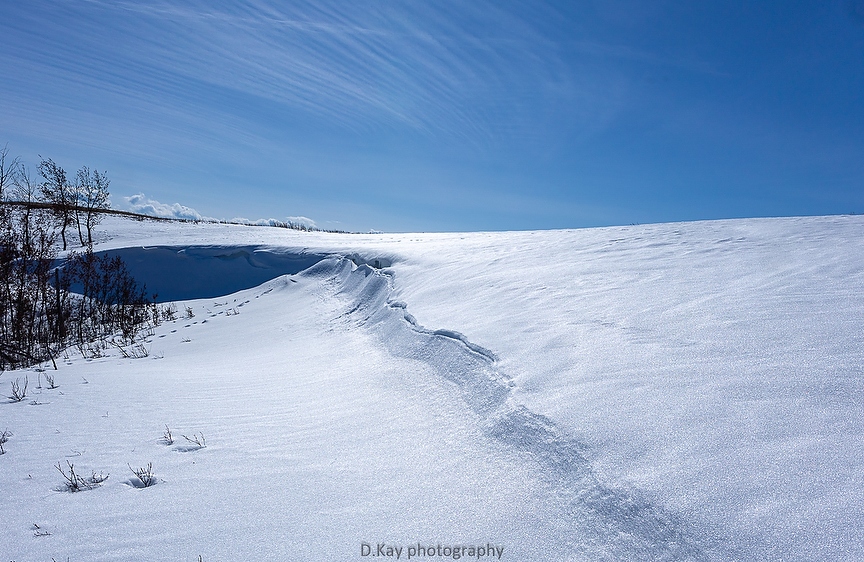
Each snowdrift consistently showed how our dominant west wind created a drift on the lee side of slopes.
Near the end of my circuit, I came across a scene that I had never witnessed before.
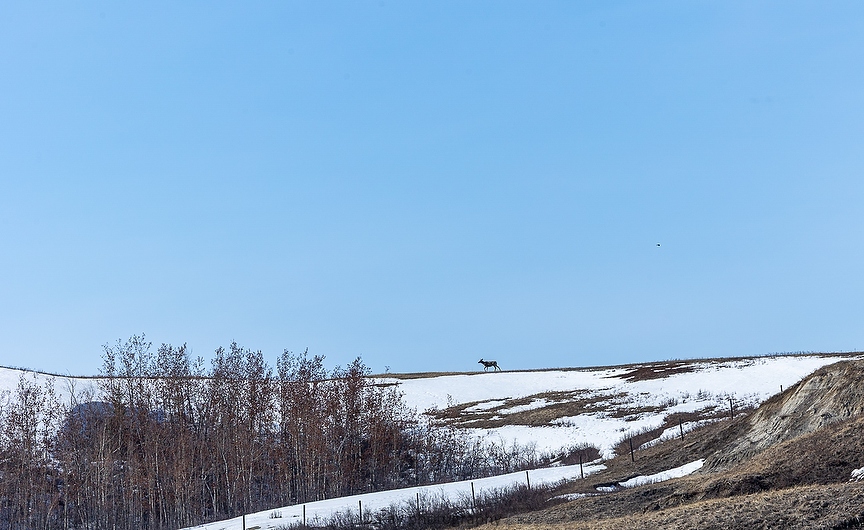
I was surprised to see an adult doe mule deer staring at me.
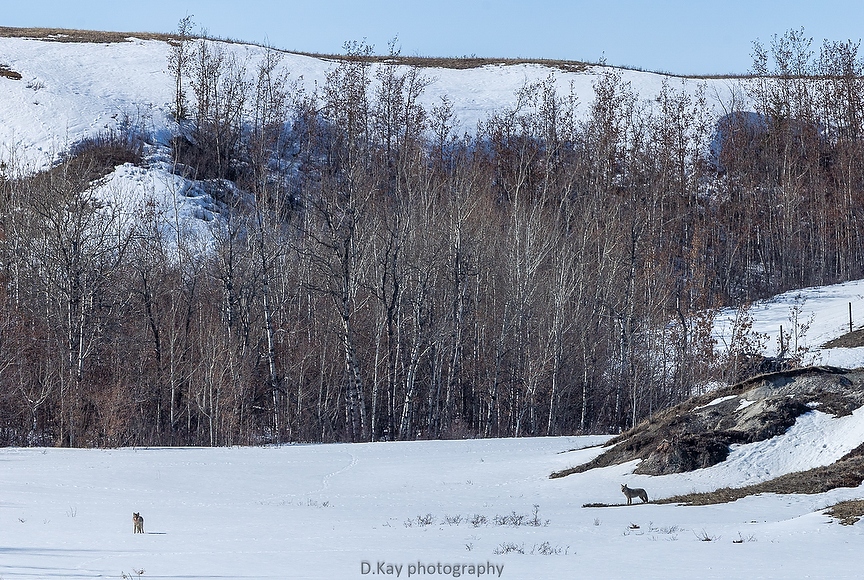
I then saw three coyotes feeding on something right in front of the doe. The coyotes were feeding on the body of a young deer.
The doe was watching her fawn being consumed by the three coyotes.
My guess is the doe was both shocked and exhausted from protecting her fawn.
In Kleskun Hills Provincial Park, coyotes are often more focused on hunting mice, hares, squirrels, and winter birds.
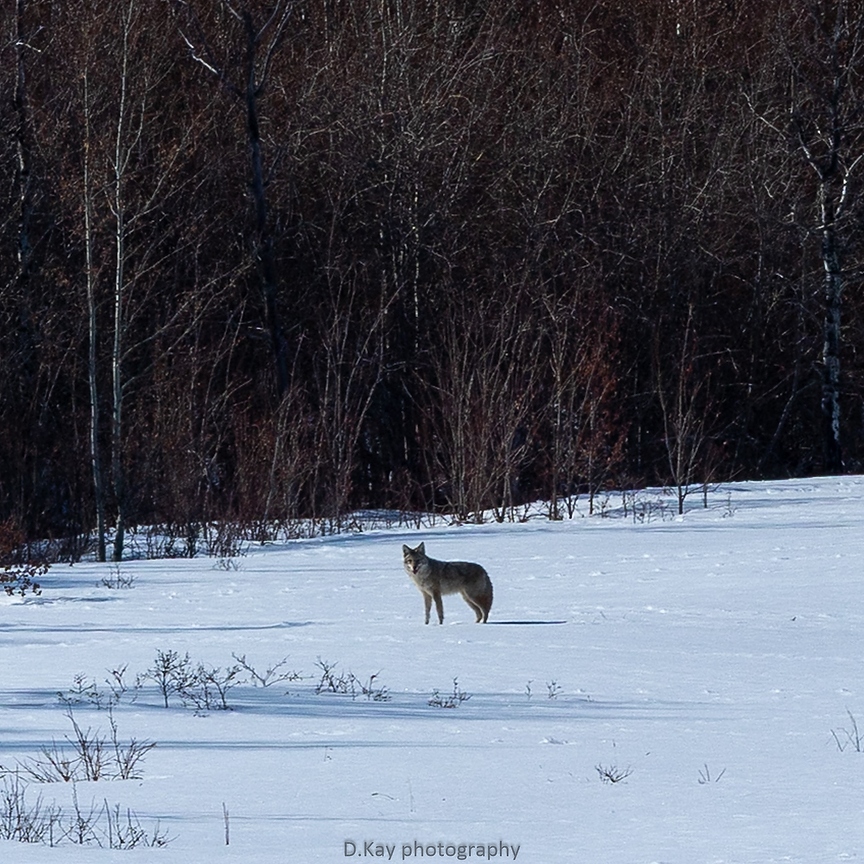
Unfortunately, I only had my wide-angle lens on my camera, and by the time I changed lenses, the doe had moved off, and the three coyotes had run away from up the valley. Defiantly, two of the coyotes stopped to look back at me.
On the scene, I looked around and found a deer bed and scattered blood and hair. Of course, the fawn could have been sick or injured, and the coyotes simply took advantage of what was available.
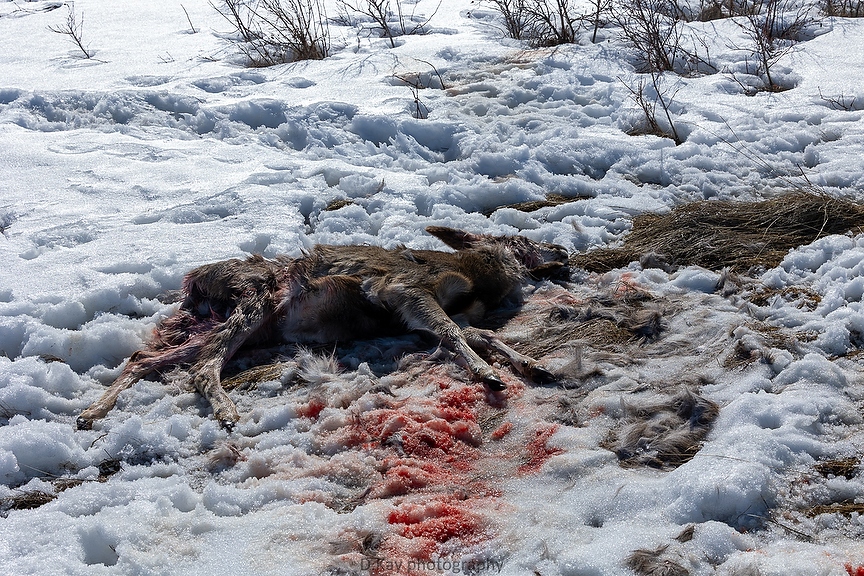
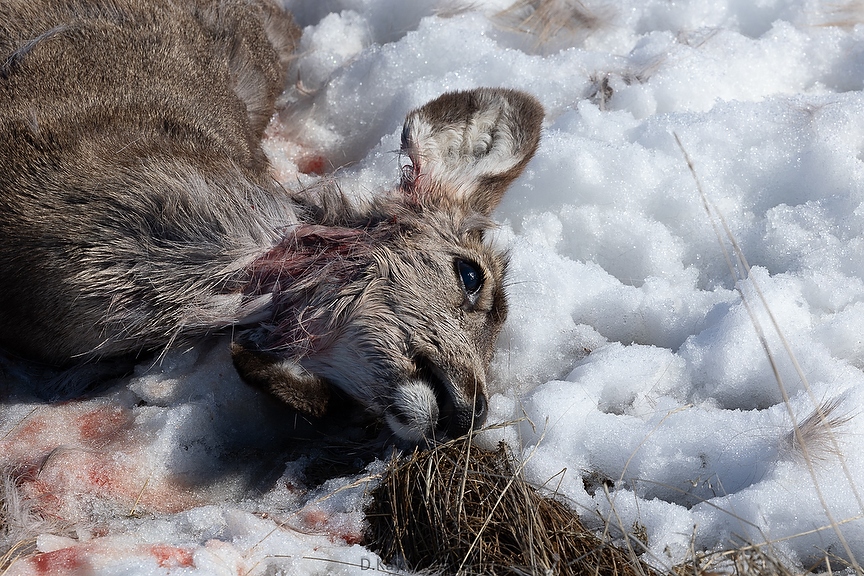
Ben Gadd in Handbook of the Canadian Rockies (1995) states that moose and deer are at their weakest condition in early April with limited or poor-quality food.
On this day, the snow cover varied, with some areas completely dry and other areas holding soft wet snow up to my knees.
Mule deer are herd animals that feel most comfortable with their herd members and in open and dry locations.
In the Park, I see herds of mule deer up high grazing on exposed grass. In the spring, mule deer herds are mostly made up of does and fawns.
A mule deer herd will have a few experienced does that watch for predators. These experienced does are smart and very observant. If a threat is detected, they have an escape plan and quickly move the herd away from danger.
This winter, Rick Scott and I photographed a pack of five coyotes in Saskatoon Island Provincial Park.
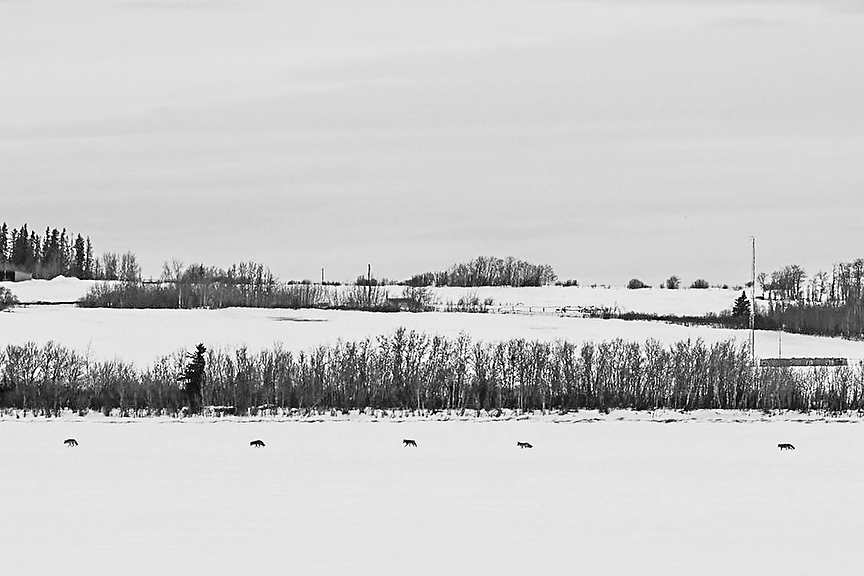
In a healthy environment, there are predators and a variety of prey. I know the Kleskun coyotes will quickly return to their kill and consume everything. The ravens, magpies, and eagles will also arrive en masse to scavenge any remaining scraps.
For me, the biggest takeaway was that I had witnessed a unique event while snowshoeing in Kleskun Hills Provincial Park.
In the park, it is possible to expose yourself to situations that are dangerous. From late July to the end of September, the park has several black bears feeding on the Saskatoon crop.
I see their beds, their trails, and their scat. During the berry season, it is safer to hike in pairs or in a small group. In the Park, if I choose to hike or snowshoe alone, I fully realize the risks I am taking.





Follow Us